
A Food Bank with No Building
Why we’re funding GoodRoots Northwest, and why we hope the rest of Washington copies them
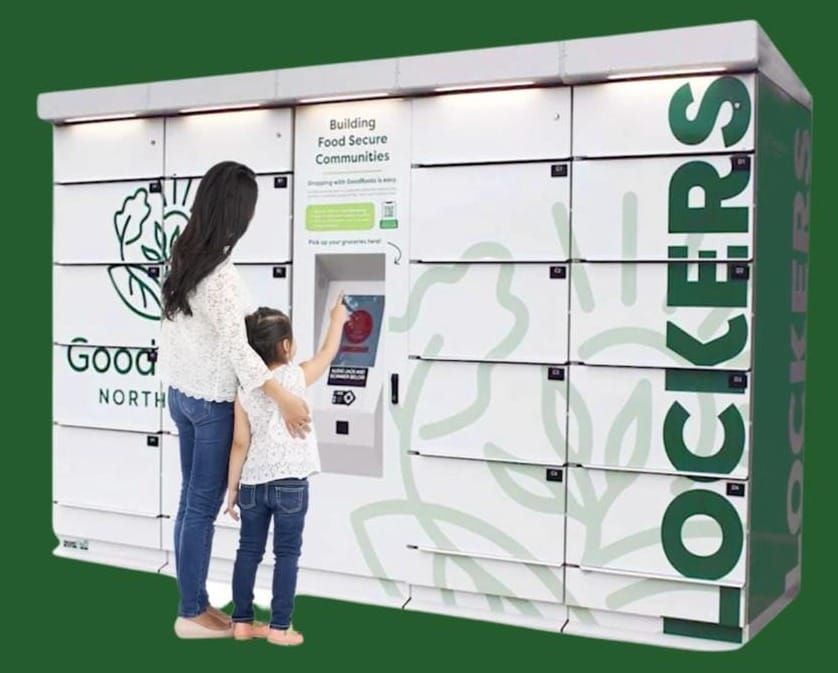
Picture a mom in Buckley who gets off a shift at 10:40 at night. Food pantries keep daytime hours, and daytime is when she works. So on her break she opened an app on her phone and picked out milk, eggs, a bag of Washington apples, some ground turkey, and chose the locker at the Rainier Fresh Country Store on her drive home. Now she types in a code, a refrigerated door clicks open, and her groceries are waiting. Nobody asks for her paperwork. Nobody watches her carry the bag to the car.
That mom is a composite, but the locker is real, and so are ten others like it across east Pierce County, in libraries, small-town storefronts, and on two college campuses. They belong to GoodRoots Northwest, and Delta Fund is proud to be funding their work. We want to explain why we got so excited about them, because the lockers are only the visible part. (They are pretty cool, though.) What GoodRoots really built is a different answer to a question most of us never think to ask: who is food assistance designed around?
Most hunger is a design problem
Stacey Crnich, GoodRoots’ CEO, puts it bluntly: “Food scarcity is not the issue—it’s a logistics issue.” She said it in a Pierce County Council profile of the lockers, and the national data backs her up.
In a December 2024 survey, the Urban Institute found that more than three in ten food-insecure adults had needed help from a place offering free food in the past year and didn’t get it. When researchers asked why, the top answers were these: 52 percent weren’t comfortable getting help. 43 percent couldn’t find a place that was open when they were available. 35 percent couldn’t get transportation, and another 35 percent couldn’t find the kinds of food they needed.
NONE of the top reasons was that there wasn’t enough food. Every one of them is a choice about how help gets delivered: open hours that assume you don’t have a job, locations that assume you have a car, and a process that asks you to be seen asking.
This study is something that energizes Crnich. “Imagine any other industry where these statistics were your consumer profile,” she said, “and the entire industry decided to do nothing about it except build more buildings that do the exact same thing.”
What the old model actually runs on
It would be easy to blame all of this on tight budgets and too few volunteers, and some of it is exactly that. But the traditional model has problems no amount of goodwill fixes, because they’re built into where the food comes from and how the people who need it get treated.
Start with the food. Federal tax law gives businesses an enhanced deduction for donated food inventory: roughly what the food cost them plus half the profit they would have made selling it, up to twice the cost. The rules say the food has to meet federal food-safety standards on the day it’s donated, and nothing stops a store from waiting until the last possible day. Donating also saves the store a dumpster fee, and researchers at Northeastern University found that stores that pull imperfect produce early and donate it can charge up to a third more for what stays on the shelf. Every incentive points the same direction: off the shelf, out the back door, and onto a food bank’s loading dock as close to the end of its life as possible.
The people on the receiving end know what arrives. When Crnich took over GoodRoots in 2020, more than 70 percent of the food donated to them was unusable and had to be passed along to an animal farmer or thrown in the trash. She remembers one watermelon in particular, donated by a major Northwest retailer. It was cracked in half, with two-inch mold growing out of the center. She drove it back to the store’s loading dock and asked the manager why a multibillion-dollar company would carry that watermelon to the donation pallet instead of taking the same 20 steps to the garbage. The manager apologized. Crnich understood it would keep happening anyway, because nothing discourages it. “In fact,” she told me, “it’s highly incentivizing the opposite behavior.” That year she ended every grocery rescue partnership GoodRoots had except one, with Whole Foods.
Pantry clients describe the same thing from the other side of the table. “You got to pick through,” one told researchers in a 2024 study. “It’s just like the dogs out there in food that somebody else don’t want.” The store gets the write-off and skips the trash run. The pantry gets the sorting, the spoilage, and too often the trash run too.
Then there are the hours. Most pantries open when volunteers are free, which is exactly when working people aren’t. The same study heard from people who stood “two or three hours outside in the cold, or in the heat, or if it’s raining,” time carved out of picking kids up from school and getting dinner on the table. “It can be humiliating,” another said, “because you have to be there getting in line really early.”
And at many pantries, there’s no choosing at all. Every family gets the same pre-packed bag, whether they keep halal or kosher, are managing a child’s peanut allergy or a parent’s diabetes, or have never once cooked with canned beets. It’s no surprise that 35 percent of the people in the Urban Institute survey said they couldn’t find the kinds of food they needed. In a Baltimore study, families served by pre-packed pantries still had about a third of their bag unused when researchers checked back, compared with under a quarter at pantries that let people choose.
And then there’s how people are treated once they reach the front of the line. In her book Feeding the Other, communication scholar Rebecca de Souza describes a pantry where a volunteer is always required to walk alongside clients as they choose food, to make sure nobody takes more than allowed, on top of income checks and visit limits. When the whole operation is organized around rationing scarce donations and screening out cheaters, suspicion becomes the house culture, even among people who signed up to help.
The longtime anti-hunger advocate Andrew Fisher has a name for this arrangement: the hunger industrial complex. In his book Big Hunger, he found an almost unanimous refusal among the country’s food banks to push for upstream fixes like a higher minimum wage, in part because so many depend on grocery and retail companies for donations and board members. The system, he says, “exists at the intersection of waste and want.” It turns a company’s waste problem into a tax benefit and a feel-good story, while the families in line are often working for wages that left them there.
That is the model GoodRoots walked away from.
From pantry to lockers
GoodRoots started in 2009 as the Bonney Lake Food Bank. Crnich took the helm in 2020, ten days before the COVID lockdowns. Under her leadership the pantry became The Market, a grocery-style store where people chose their own food and checked out with a Market Card that looked like any other store loyalty card. She has talked about how something as small as that piece of plastic can change how a person feels about themselves.
The first lockers went in during 2022. The pilot unit near The Market went on to become, according to its manufacturer, the most-visited nonprofit locker in the country. In February 2024 they cut the ribbon on a locker at the Bonney Lake Library, and I love the symbolism they chose for it: libraries give everyone access to knowledge, and the locker gives everyone access to food. Since then the network has grown to Orting, Wilkeson, Carbonado, South Prairie, a second Buckley site, Pierce College, and Bates Technical College.
Then, in November 2025, GoodRoots did something Crnich says no food bank in the country had done before. They closed the in-person pantry entirely and moved to 100 percent lockers. “The real mission was never about a building,” she told the Courier-Herald. “It was always about whether families could reliably get food when they needed it.”
Here is how it works now. Membership is free. You order online or by phone or text, once a week, and pick up any time of day or night with your own code. The lockers are refrigerated, stocked with Washington-grown food, and built with Braille instructions, a headphone jack, and a multilingual app. GoodRoots now processes 250 to 350 orders every day, more than 400 in peak months, and estimates about 140,000 visits a year. A single GoodRoots locker outperforms 95 percent of the brick-and-mortar food banks in Pierce County.
Very little of that food goes to waste. Because members order ahead and inventory is tracked online, GoodRoots’ food waste is now audited by Greenwold Ohlund at 2.7 percent. Whatever surplus remains goes to local school culinary programs, where students turn it into healthy frozen meals while the food is still at its best.
Dignity turns out to be infrastructure
The line from Crnich that stuck with me most is this one, from a piece she wrote this spring: “It’s the dignity of your own anonymity. We have a system in place that’s so automated that we never need to lay eyes on you as a provider.”
Hold that next to the Urban Institute number. The single biggest reason people go without help is that they aren’t comfortable asking for it. GoodRoots didn’t try to talk people out of that feeling with a better welcome sign or a friendlier volunteer script. They designed the asking out. For working parents, rural families, and anyone who has been poorly served by daytime-only, English-only systems, Crnich writes, that anonymity and round-the-clock access “are not nice-to-have.”
Crnich has watched a lot of moms pull up to the lockers with kids strapped into car seats. One evening she was showing a locker beside a fire station to a visitor, and she hung back while a mother picked up her order. Once the mom had driven off, she turned the car around and came back. Crnich walked up as she rolled down the window, and the lights from the side of the fire station lit up the little faces in the back row. It was her first time using the lockers, and she wanted to say thank you. Crnich told her that her own tax dollars pay for the social safety net, so she was only drawing on something she had already paid for, and that she hoped she liked what they’d done with her money. The mom took a few seconds with that. “Very much,” she said.
There’s a lovely side effect, too. The Buckley locker sits inside the Rainier Fresh Country Store, and its owner, Patrick Brown, pointed out that someone can pick up their free groceries and then shop in his store. Food assistance that sends customers to a small local business is food assistance that keeps money in the town. GoodRoots has also said it plans to invest in local agriculture “in a much more significant way,” which is exactly the kind of root-level thinking we hope to see.
A floor people can actually reach
Our theory of change has four levers, and one of them is Prevention: securing a floor of basic security for everyone before harm happens. When we brought MyFriendBen to Washington, the logic was that millions of families already qualify for support they never receive because the benefits system is a maze. GoodRoots applies the same insight to dinner. The food exists. The floor exists. The work is making it reachable, at an hour people are free, without asking them to perform their need in front of anyone.
One of GoodRoots’ cultural principles is “a mission to work ourselves out of a job.” This connects to some of our other work. A locker doesn’t fix the reason a family in Pierce County is short at the end of the month. Wages, rent, and child care costs do that, and those are bigger fights. What I appreciate is that GoodRoots doesn’t pretend otherwise. They describe a future where food assistance isn’t needed and treat their own work as a bridge to it, which is the posture we look for in our partners.
None of this is magic
Lockers cost real money. The Ben B. Cheney Foundation puts the buildout at roughly $100,000 per location, and GoodRoots has pieced the network together from county grants ($174,000 from the Pierce County Council), foundation support, and an equipment line of credit. That funding has to come from somewhere every time the network grows.
The model also asks people to order ahead, and not everyone has a smartphone or a reliable data plan. GoodRoots takes orders by phone and text for exactly that reason, but digital access is a barrier worth watching as the model moves into more rural places. And something real was lost when The Market closed. Crnich has been gracious about it: “Some will always love the human connection of an in-person space, and I respect that deeply. But overwhelmingly, families have told us the lockers match their lives better.”
We take that tradeoff seriously. We also notice who it was decided for. The people who used the system told GoodRoots what fit their lives, and GoodRoots listened, even though it meant giving up the building that had defined them since 2009. We see that so rarely in the nonprofit world (or anywhere, honestly) that it’s one of the main reasons we said yes.
The locker is the vessel. The food is the point.
There's one more piece I don't want us to miss, because it's easy to overlook. It doesn't come with a ribbon-cutting or a plaque. A locker is a vessel. What matters most is what's waiting inside when that door clicks open.
In one year, back when federal dollars for feeding our neighbors were still flowing, GoodRoots spent $500,000 buying directly from local farmers. Think about everything that one budget line did. Families got fresh, Washington-grown food picked days ago instead of weeks ago. The food traveled fewer miles and less of it was wasted. And farmers in our own region had a buyer they could count on, so they could plant with confidence the next season.
Much of that money is gone now. Since January 2025, USDA has canceled about $1.16 billion in programs that helped food banks and schools buy directly from nearby farms. That's roughly $500 million through Local Food Purchase Assistance and $660 million through Local Food for Schools. For Washington, it meant about $20 million that would have gone to our own growers. Planned emergency food deliveries to food banks were also canceled or interrupted.
Then the July 2025 budget law went after SNAP, which provides nine meals for every one a food bank can. Here at home, an estimated 170,000 Washingtonians stand to lose their benefits. Others will see about $56 less each month. Our grocers, farmers markets, and farmers lose at least $360 million a year in sales. Our state legislature has worked hard to hold the line. It protected $93 million for emergency food and is now spending more than $370 million to backfill federal cuts. But a state facing its own deficit can't keep catching everything Washington, D.C. drops.
GoodRoots, like food banks across the state, is absorbing a $500,000 hit at the very moment more families are placing orders. So who patches that hole?
For now, we believe philanthropy has to. $100,000 builds a locker, but it doesn't fill one. If we fund the steel and glass and then walk away from what goes on the shelves, we risk sending families right back to the loading-dock leftovers this whole story is about. So here is our ask of fellow funders: pair every locker grant with a commitment to purchasing power. That means real cash, ideally over several years, for fresh produce, eggs, dairy, good protein, and the foods families actually cook and love. Choice is only dignity when the choices nourish.
This is all one system, our food shed. Healthy soil grows food that a local farmer can sell at a fair price. That food reaches a family's table. A child shows up to school fed and ready to learn. A grandmother managing her diabetes doesn't have to trade her health for whatever was left on the pallet. Steadier blood sugar means steadier moods, fewer clinic visits, and more patience at the end of a hard day. Every dollar spent with a nearby farm circulates through our small towns again and again, instead of leaving on a long-haul truck. Nourishment, local economy, healthy minds, bodies and spirits, land, and climate all rise or fall together.
Public budgets are cutting into the very communities that can least afford it. Philanthropy can't fix that alone, and we shouldn't pretend to. But we can show up and fill the gap with good food, while we keep working toward a country whose budgets reflect how we hope to treat and care for one another.
Why we want to see this across Washington
We are concentrating our newest work in Washington so the pieces can reinforce each other in one place and others can copy what works. Crnich has said directly that the model was built to travel: “What GoodRoots has built is not a custom solution engineered for a single organization. Our model is replicable.”
She has done a lot more than say it. Since 2023, Crnich has given around 400 tours a year, to anyone who wants to come and learn, no matter what she knows about their organization. Her thinking was that if she could demystify the model, others would pick it up. Very few have.
People assume some tech and a nice paint job will do the trick, she said. The hard part is the culture inside other organizations: the volunteers, donors, and board members who keep the old model running, and who are not the ones going without food. Changing the model means telling well-meaning people that what they have been doing isn’t working. “It’s shocking to me how many people aren’t willing to push against systems in place and get to the part of change where feelings inevitably get hurt,” she said. “Even when children are hungry.”
She is quick to say there is nothing special about her, the lockers, or the model. What she thinks sets GoodRoots apart is a willingness to sit in discomfort, to build without a roadmap, and to really feel that their neighbors are them. She thinks part of what holds others back is the standing that comes with being a helper. “So easily the approach is that ‘helping is enough,’” she said, and the label can leave people feeling above reproach.
Funders are part of that culture. We sit on those boards, and our grants keep a lot of the old buildings open. So we read her answer as a challenge to us as much as to food banks.
The ingredients already exist in most of the state. Nearly every small town has a library, a community college nearby, or a local store with a few square feet to spare. Regional networks like Food Lifeline, Northwest Harvest, and the Emergency Food Network already move food across the region, and GoodRoots counts all three among its partners. The lockers and ordering software are off-the-shelf, and Crnich has been handing out the playbook for years.
So if you run a food bank, a county human services office, or a community foundation anywhere in Washington, we hope you’ll take her up on a tour. And if you’re a funder looking for something concrete, a single locker is about as tangible as a grant gets: a known cost, a host site in a trusted place, and hundreds of families a week who no longer have to choose between their shift and their groceries. We would love to fund alongside you.
Somewhere in Washington tonight, someone is getting off a late shift. The food is there. Whether she can reach it depends on decisions people like us get to make. GoodRoots made theirs. We’re excited to help the rest of the state make the same one.
Member discussion