
Five Truths We Can No Longer Ignore
For twenty years, those of us in philanthropy and impact investing were sold three comfortable stories, and we bought all three.
The first was impact investing. Put your money in the right funds and markets would fix what markets broke. The second was win-win. You could do well and do good at once, and never have to choose. The third was Paris. The world's governments had agreed to hold warming to 1.5°C, and the grown-ups were in charge.
The test of any of these stories is simple: follow the money.
Open the two biggest ESG stock funds in America, from iShares and Vanguard. About 40 cents of every dollar sits in roughly ten companies: Nvidia, Apple, Microsoft, Amazon, Alphabet, Broadcom, Meta, and Tesla. These are the same names that top the S&P 500. I worked at Facebook for eleven years and left because of what I saw there. Today Meta sits in the top ten of America's biggest "ESG" funds. ESG didn't move capital. It relabeled it.
Win-win paid out too, but only to one side. In 2024, S&P 500 companies handed their shareholders a record $1.57 trillion in buybacks and dividends. The rest of us didn't get a better life out of it. Those same years gave us record fortunes at the top and the cost-of-living anger now filling the streets of Europe.
And Paris? Ten years on, fossil fuel use is still rising, and 1.5°C is effectively gone.
These stories made us feel like progress was happening. The numbers say otherwise.
I don't blame the people who believed them. We believed them too, and most people I know in this work are honest and mean well. The stories failed because they asked a system to fix itself while every incentive in it pointed the other way. It’s time to look at what the evidence says, even when it’s uncomfortable. Here are five truths we can no longer ignore.
1. We will pass 2°C. Plan for that world.
Scientists can calculate how much more carbon the world can burn before it passes 1.5°C. At the rate we burn it now, we use up what's left in about three years. At today's pace, the world passes 2°C in the 2040s, and that pace may be optimistic: the International Energy Agency expects the electricity used by data centers to more than double by 2030, much of it for AI. Under the policies governments actually have in place, the UN projects 2.8°C by 2100.
2°C sounds mild. But it is an average, and no one lives in the average. In June 2021, a heat dome killed at least 112 people in Washington State, many of them alone in homes without cooling. That is what a global average looks like on one street in one week. A hotter world brings more of those weeks, and they land hardest on the people least able to get away.
The money to cope isn't there. About $64 billion went to climate adaptation in 2024. Developing countries will need $310 to $365 billion a year by 2035. Today's flow covers about a fifth of that.
Every long-range plan you hold, from your foundation's strategy to your grantees' programs to your portfolio's models, assumes a climate that won't exist. Stop planning for the world we promised. Plan for the one we're getting.
2. Inequality this extreme doesn't end peacefully.
This month the town hall in Limoges burned. More than 550,000 people marched across France, more than a thousand were arrested, and the unrest spread to Milan, Brussels and Lisbon. The people in the streets talked about rent, prices, wages and school fees. They were describing one thing: falling behind while the top pulls away.
None of this would surprise Luke Kemp. His book Goliath's Curse traces 5,000 years of societies and finds the same arc again and again. Wealth and power gather in fewer hands. The society loses its ability to absorb shocks. Then it breaks. Extreme inequality has rarely come down without war, revolution, plague or collapse.
Peter Turchin calls the mechanism a wealth pump. Gains flow up, ordinary people fall behind, and politics breaks. In 2010, writing in Nature, he warned that "the next decade is likely to be a period of growing instability in the United States and western Europe." Look around.
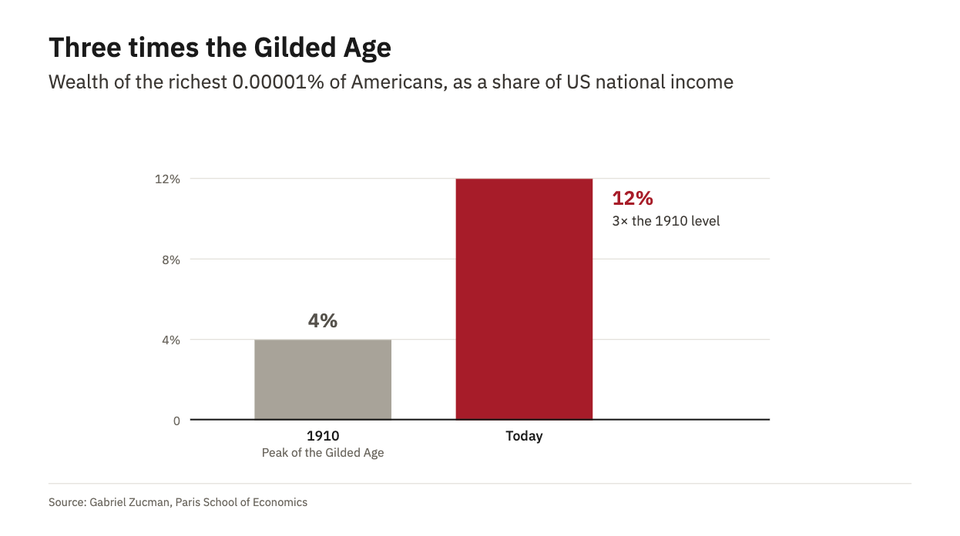
Averages hide this too. When the richest few gain enough, average wealth rises even as most families fall behind. So look at the top. In 1910, at the height of the Gilded Age, the richest 0.00001% of Americans held wealth equal to 4% of national income. Today it is 12%. Three times the Gilded Age. The pump is still running, and nothing philanthropy or impact investing funds today is turning it off.
3. AI will pour fuel on the pump.
At Facebook I watched what billions of people built turn into gains for shareholders, not for the people who built it. No one there set out to do that. It is what the ownership structure produces. AI runs on the same structure, only faster.
Economists Daron Acemoglu and Pascual Restrepo found that automation explains 50 to 70% of the change in American wages over the last four decades. That was before AI. The rule is simple: whoever owns the machines gets the gains. Right now that is a handful of companies, the same ones filling your ESG fund.
Who owns AI is being decided now. Once the gains are captured, it will be too late to share them.
4. Modern philanthropy delivers neither security nor system change.
This moment needs two things: security for the people already taking the hits, and change at the root so the hits stop coming. Philanthropy, as it is built, does neither.
If you want to know what an institution cares about, don't read its mission statement. Look at where its money goes. US private foundations held a record $1.64 trillion in 2024 and gave away about $105 billion. For every dollar granted, about sixteen dollars stayed invested, chasing returns in the same markets driving the crises the grants try to fix.
The people running these endowments are not villains. Most of them are thoughtful people. The law asks a foundation to give away 5% a year and asks almost nothing about what the other 95% does. Investment committees are judged on returns. Under those rules, investing in the harm is the rational choice. That is the problem. In February we showed you what this looks like at Ford and Rockefeller. Zoom out and it is the whole field. The endowment does more to the world than the grants ever will.
Think of the band on the Titanic. Brave. Beautiful. And not steering. For years, we played in that band too. Then we looked hard at what our own money owned, and we changed it.
5. Reform is now the risky choice.
Human extinction is unlikely. Mass loss of life is not. A team led by Tim Lenton estimates that at about 2.7°C, close to where we are headed, some 2 billion people, more than a fifth of humanity, will be living in dangerous heat by the end of this century. Kemp, the same researcher who studied 5,000 years of collapse, led a group of climate scientists warning that these catastrophic outcomes are the least studied and the ones that matter most.
Meanwhile, reform keeps getting undone. The US passed its biggest clean energy investment in 2022 and cut most of it in 2025. New Zealand built its budget around wellbeing, and the next government moved to strip wellbeing out of the law. Minimum wage gains have to be won again and again. Political scientists Martin Gilens and Benjamin Page found that average Americans have almost no independent influence on federal policy.
We keep choosing small fixes because they feel safe. They aren't safe anymore. A fix made inside this system gets undone by this system. The safe choice now is to change the system itself: who owns, who benefits and who decides.
What we suggest
Here are three things we suggest.
First, if you run a foundation, move your endowment. Invest the 95% in the same goals you fund with the 5%.
Second, if your family has wealth, ask your advisor one question: what does my money own? Then stop owning the harm you give money to fix with your philanthropy. Getting out of the harm is only half the job. The other half is investing in the things that make life better: the businesses, housing and communities you want to see.
Third, whoever you are, fund the root, not just the symptoms, and hand the decisions to the people who live with the results.
We are trying to do this ourselves, and we are still learning. We sold all of our public stocks and rebuilt our portfolio around employee ownership, community lenders and community-owned housing. Through Unlock Ownership, we are putting ownership in the hands of workers and families. In Washington State, we brought MyFriendBen to families who are owed benefits they never receive, we invested in a better model for food security with GoodRoots Northwest, and we are building a citizens' assembly that hands real economic decisions to residents.
None of it is enough on its own. That is the point. We need you.
The comfortable stories are over. The truth is hard, but it is useful. It tells us where our money needs to go. Let's move it there together. Join us.
Member discussion