
Mission Activation: Capital Needs to Stop Apologizing and Start Building

Most conversations about responsible investing get stuck on a single question: how do we keep our money from doing damage? It's a fair question, and an important one. But it's also a low bar. If the whole ambition of your portfolio is to be less bad than the alternative, you've accepted that capital is, at best, a liability to be managed rather than a tool to be used.
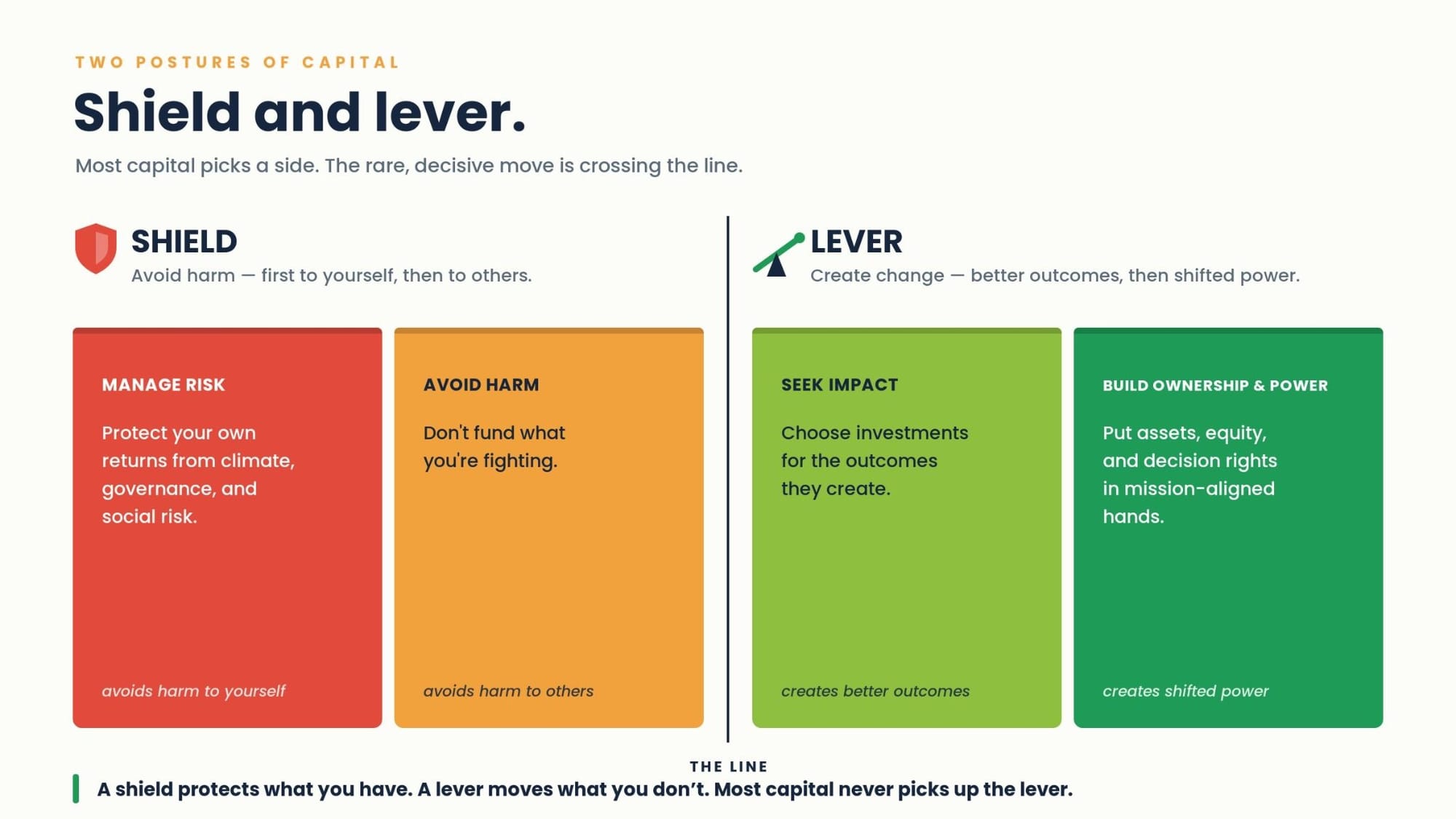
For years we've described responsible investing as a ladder, a series of rungs you climb from doing no harm at the bottom toward doing real good at the top. It's a tidy story, and it's wrong. Almost nobody actually climbs it. The honest picture isn't a ladder at all. It's a line, with a shield on one side and a lever on the other. What happens instead is that capital picks a side and stays there, often for the life of an institution.
A shield protects. A lever moves things. They are two fundamentally different ways of holding money in the world, and the gap between them is the most important thing the old ladder obscured.
Defensive Steps
Managing risk. This is where most of the ESG industry actually lives. The logic is that climate exposure, weak governance, and social controversy are financial risks like any other, and that pricing them in protects returns over the long run. This is risk management, and despite all the values language wrapped around it, that's really what it is: avoiding harm to your own returns.
ESG-as-risk-management is a defensive posture dressed up as values. It asks how the world might hurt your money, not how your money might change the world.
Avoiding harm. This is just above the floor (where you focus entirely on financial returns for yourself), and it's mostly a screen. Don't fund what you're fighting! Get out of the bad! If your foundation exists to address climate change, don't hold the companies expanding fossil fuel extraction. If you work on public health, the tobacco and predatory-credit positions have to go. Here you're shielding the world from your money rather than the other way around. Exclusion is simple to understand and simple to implement, which is exactly why it became the default face of "ethical" investing. It's necessary. It is nowhere near sufficient.
The Shield Posture
Together, managing risk and avoiding harm are the responsible-investing consensus. Protect your returns, then maybe keep your money from doing damage. This is also why so many mission-driven investors feel a quiet dissonance; they've done everything the playbook asks and still can't point to a single thing in the world that is different because of how they invested. A shield has never made something new. It was never meant to.
Steps to Activate Your Mission
Cross the line and the focus shifts significantly. The right two activities stop treating impact as a constraint on the portfolio and start treating it as the point of the portfolio. A lever isn't about what you avoid; it's about what you can move. Lever capital stops asking "how do I keep my money clean?" and starts asking "what can this money actually shift?"
Actively seeking impact. The shift is subtle in language and enormous in practice: you choose an investment because of the outcomes it creates, not merely despite of the ones it avoids. You back the affordable-housing developer, the community lender, the clean-energy project in the market everyone else has written off, not because the screen permits it, but because the result is the reason you're writing the check. Returns still matter. But the outcome moves from a side effect to the whole point. You are now underwriting change, and you can name what that change is.
Building ownership and power. This is the action almost no one talks about, and it's the most consequential. It is where true “impact first” lives. Here you use the structure of the deal itself to move assets, equity, and decision rights into mission-aligned hands to shift power. It's the difference between funding a solar installer and financing the conversion of a company into one owned and governed by the employees. Between buying green bonds and insuring a board seat keeps a company green after the press release fades. Between renting impact and owning it. When you operate on this level, the question isn't just "what does this investment produce?" but "who ends up holding the power when it's done?" Capital, deployed this way, doesn't just chase good outcomes; it rearranges who gets to make decisions in the first place.
The Point of Impact First is to Build The World We Want
The reason this framing is worth adopting is that it exposes a comfortable illusion. An institution can run a flawless shield - screen perfectly, score every risk, publish the glossy report - and have changed nothing about the world in which they live. That's not a failure of execution. It's the shield doing exactly what a shield does. Protection and creation are different activities, and no amount of excellent defense ever adds up to offense. Only the second pair compounds.
It also clarifies where the hard, scarce, valuable work is. The shield is familiar, defensible, and easy to outsource. Screening is now largely automated; risk scoring is a commodity any consultant will sell you. What can't be commoditized is the intimate knowledge of your values, the judgment to identify outcomes worth backing and the patience and skill to structure deals that shift control. Those are the activities that actually bend trajectories, and they're where mission-driven capital has an edge that conventional capital structurally lacks.
None of this means dropping the shield. You don't fund what you're fighting, and you don't ignore real financial risk; defense is table stakes. But carrying a shield is not the same as picking up the lever, and we should stop pretending the first quietly becomes the second if you just do it well enough. It doesn't. They are two different motions.
The advice most of us get keeps us from directly making things worse. The work that matters most is the work that makes something new: assets in different hands, decisions made by different people, power held closer to the communities a mission is meant to serve. That's mission activation. That's the lever. It sits on the far side of a line that most money never crosses, and crossing it is the part of the work where your capital is truly working for the world we want to live in. And from our experience, it’s really exciting.
Member discussion